

Article written by Christian & Company Marine Surveyors
Here’s a puzzle. This one’s for the motorheads, but anyone can try to solve it.
The vessel in question is a 25-year-old sportfishing vessel equipped with two diesel engines. The problem reported was water in one engine—a lot of water.
The water had apparently sat in the engine for some time and was causing problems, as water inside an engine will.
The question was, how did the water get there?
Mechanics performed an initial inspection and determined the engine was going to require a rebuild, to an unknown extent. The injectors had been pulled, and a strong mechanic could not turn the engine with a long lever and a socket on the crank shaft.
The mechanic’s initial diagnosis was a failed aftercooler. The aftercooler was removed, pressure tested with no apparent leaks, and disassembled. There was no indication that water had entered the air chamber of this aftercooler/boost cooler.
So now what?
The mechanics wanted to continue the disassembly to determine the scope of damage and move forward in the repair process. As I was tasked to determine the cause, I greenlit the disassembly, but asked them to save all components and, as they were experts in that brand engine, I asked them to look for anything unusual.
At the time of my inspection, the starboard engine (the one that was full of water) was partially disassembled, with the head off and all other pieces necessary to remove it stored in the engine room. Prior to disassembly, it had been determined that the engine was full of water and the coolant was at the normal level.
We traced the seawater system for the port engine. Through hull—sea strainer—fuel cooler—seawater pump—aftercooler—heat exchanger—gear oil cooler—exhaust mixing elbow. A fitting connected between the seawater pump and aftercooler provided water to the lip type dripless shaft seal; a cross over hose connected the two shaft seals. The exhaust system included a high riser, dropping into a water lift muffler, and discharging through the transom, slightly above the waterline with no external flaps.
Water Lift Muffler
That should be enough for the forensic mechanical engineers, with boat experience and Mensa membership. For the rest…
The mechanic stated that the owner’s initial complaint was that the starboard engine had overheated; the mechanic had removed the water pump and what was described as a “defective impeller” had been discarded. The mechanic had taken the aftercooler, which he suspected as being involved in the incident, and pressure tested it as described above.
There was build up inside various components in the seawater system: in the heat exchanger, transmission oil cooler. It was the normal calcium, salt, and minerals, as well as some debris, including several pieces of pencil zinc anodes.
We were able to determine that there had been an overheating event; one event was recorded on the day the owner experienced the problem. The owner clarified that the starboard engine overheated, he decided to stop running the engine, and was towed back to his normal slip. He stated he ran the other engine while being towed.
We inspected the cylinder walls; there was no scoring. There was a trail of seawater and corrosion in all the exhaust system components. The mechanic stated that he discovered the exhaust system full of water during the disassembly process.
The owner was the original owner and was religious about maintenance; he kept a very detailed, hand written, maintenance log. When questioned if anything like this had ever happened before, he recalled another event which resulted in water in the starboard engine. He stated that there was a problem with the starboard engine many years prior, he ran the vessel back to its normal slip using only the port engine, and, shortly thereafter, water was discovered in the starboard engine. The water was removed, the engine was saved, and no water had ever been discovered in the engine until this incident.
Here are a couple visual hints:

Shaft seal water supply hose attached to elbow, near engine’s seawater pump
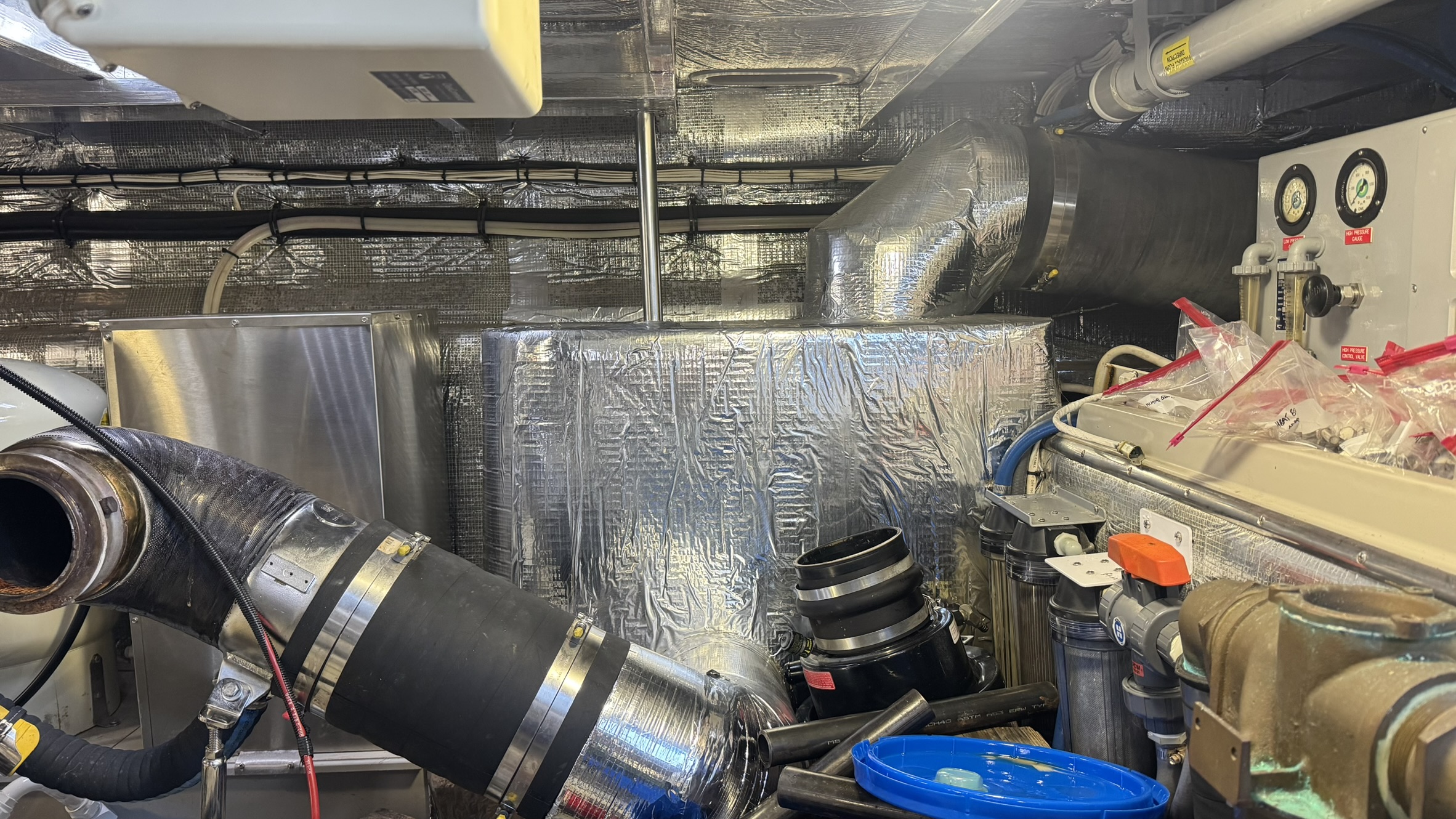
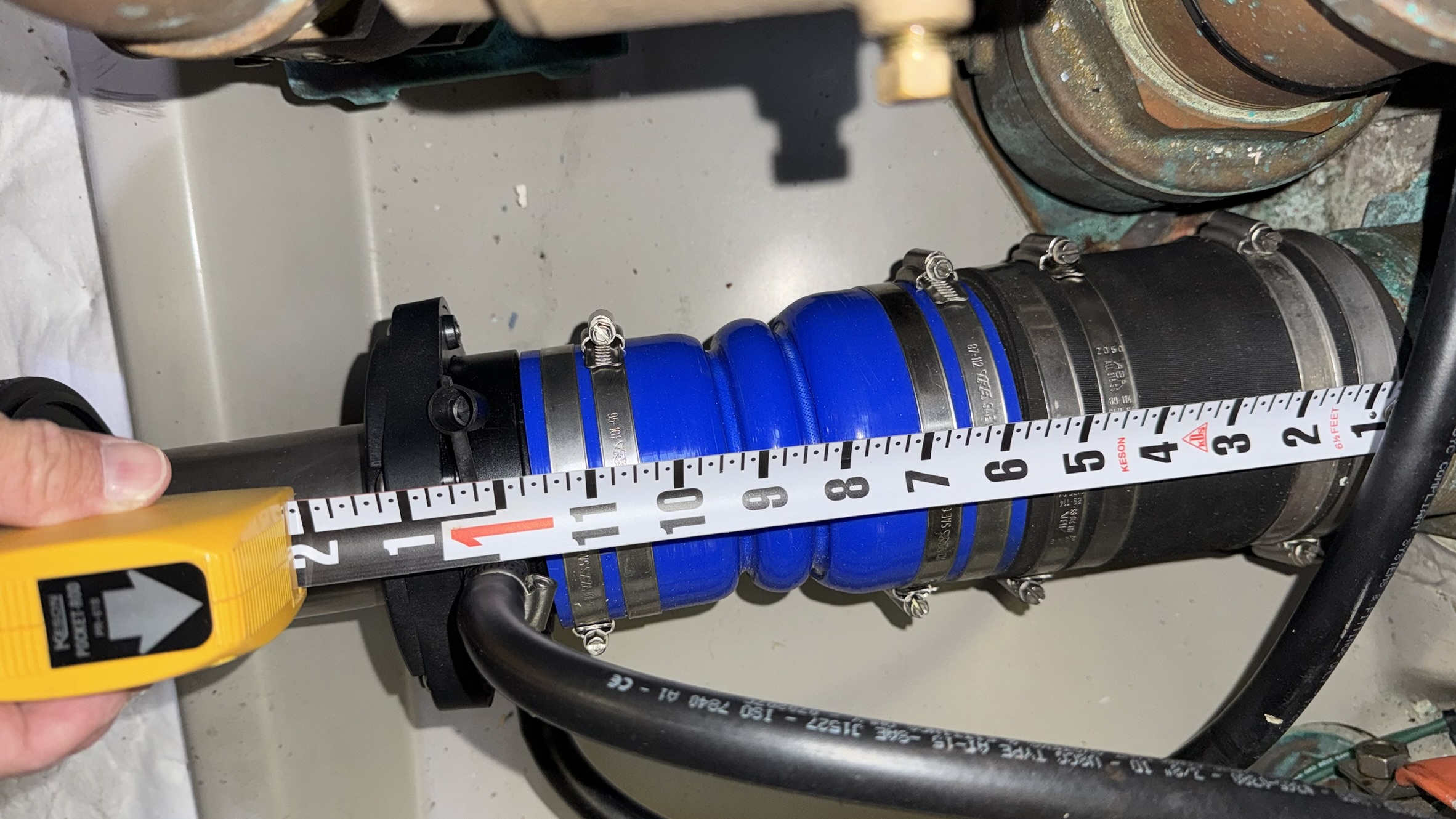
Shaft seal coupled with two “Pedro hoses”
Seawater supply hose and cross over hose visible
At this point the mortal forensic mechanics either know what happened, or have an idea(s).
If you haven’t solved it, but feel you can, stop reading, go back and try again.
The inspection made it clear that the water had come in through the exhaust system, but why?
The water somehow flooded into the engine during the tow, perhaps the tower had brought the vessel alongside his boat prior to entering the harbor and waves, a reverse motion of the boat, or both had allowed water to fill the exhaust system? There was no flapper on the transom exhaust discharge fitting, but there was a muffler, shouldn’t the baffles stop that?
And what about the overheating? How could that have contributed to the seawater filling the block?
I concluded that the overheating incident did not result in any damage, it just resulted in the owner having the vessel towed in. It didn’t seem that the tow would cause water to fill the engine. Maybe there was an Archimedes screw, a device that allows water to move uphill? I recalled one boat in my youth that would do this if you rocked it back and forth, allowing a finite amount of water to move up the exhaust system, but that would be highly unusual. There must be a simpler solution. What other source of water was there?
There was a connection to the seawater system, supplying the shaft seals, and the shaft seals had a hose between them. I returned to the vessel to inspect the shaft seal system and perform an experiment. The shaft seal location has been moved forward, by installing a second section of flexible hose (Pedro hose), using an internal coupler and hose clamps, versus a single hose. This would increase the water pressure in the shaft seal, as it would reduce the space within the hose around the shaft.
The starboard engine had been disassembled, but the water supply hose to the shaft remained connected, and had been properly plugged and secured well above the waterline.
I removed the plug from the starboard engine’s propeller shaft seal seawater supply hose, started the port engine, and water squirted out of the hose. This was the source of the water.
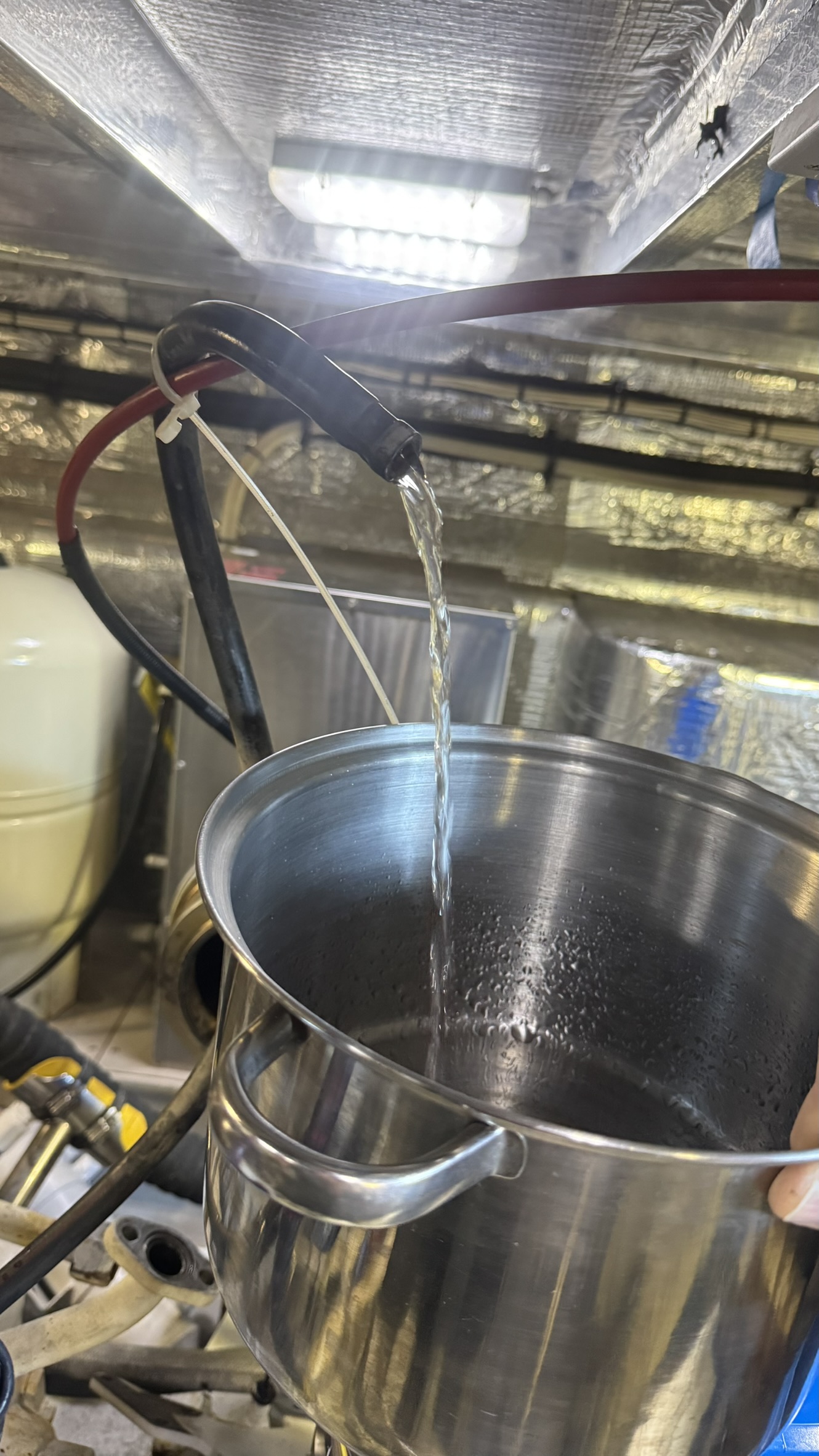
Water from starboard engine shaft seal supply hose; port engine running
The fatal flaw was the water lift muffler. Had the exhaust system been a straight shot from the riser to the discharge, the water could not have accumulated and backfilled into the engine. In this application, the exhaust riser at the engine was significantly lower than the elbow coming out of the exhaust muffler.
Because the owner ran the port engine during the tow, water discharging into the port shaft seal crossed over into the starboard shaft seal, and back fed the seawater system on the starboard engine. The water went where it normally goes, into the exhaust system, but with no exhaust to push it out, it filled the exhaust system and, eventually, the engine.
A call to the manufacturer of the shaft seal system quickly determined that the crossover tube was inappropriate in an engine application with a water lift muffler or if the injection point of the water at the engine was not the highest point in the exhaust system.
We hope you enjoyed this puzzle!
Did you correctly guess the source of the water?
Yes!
Nearly! I got a few details wrong.
No…